Monday, August 22, 2022

HOF Inductee No. 7: "I Feel For You," Chaka Khan


 And with this, Prince is now in the Earworm Hall of Fame, but only as a songwriter. Performing this song from Prince's self-title second album was ... Ch-Ch-Ch-Ch-Chaka Khan. Chaka Khan. Chaka Khan. Chaka Khan.

And that's the hook that got stuck in a million or more ear canals: the repeated name of a singer. Chaka Khan was prominent from her time with the funk group Rufus. But her career was in a bit of decline by 1984. It was at this point that super-producer Arif Mardin combined the disparate elements of a Prince song, Chaka Khan's powerful, emotive vocals, a Stevie Wonder harmonica and crowd noise sample, with that key ingredient part that turns an energetic Prince cover into an earworm legend:  a hip-hop hook courtesy of Melle Mel (from Grandmaster Flash and the Furious Five, whose career as rap pioneers also was in decline by 1984). And he only is simply repeating the singer's stage name.

Prince's second LP was his breakthrough to pop audiences. "I Feel For You" was just an album track, buried near the end of side two. "I Wanna Be Your Lover" was Prince's first hit on the Billboard Hot 100, peaking at #11 on January 26, 1980. "Why You Wanna Treat Me So Bad" was probably the best song on the LP, but it was a hit only on the R&B charts. I failed to cross over to the pop (i.e., "white") audience. And the hard rocking "Bambi" showed Prince could do a credible job with rock and roll if he chose to go in that direction (which he later did, quite often and quite successfully, on so many tracks over the years). (Footnote: For years I have dreamed of Guns & Roses covering "Bambi." It would be well within their wheelhouse, sonically and thematically.)

And then Prince's "I Feel For You" landed on Yvette Marie Stevens's vocal chords. Chaka Khan was a 1970s funk superstar who was still putting out records in the 1980s. "I Feel For You" was the title track from Ms. Stevens's sixth solo LP. But nothing much had landed with mainstream audiences from her solo career except for the Ashford & Simpson penned anthem from her solo debut Chaka, "I'm Every Woman." And, as great as was that song, it climbed only to #21 on the Billboard Hot 100 in very late 1978. She had a great career as lead singer for Rufus, but her solo career was completely stalled out.

Then Melle Mel said her name in a way only he could have done: Ch-Ch-Ch-Ch Chaka Khan Chaka Khan Chaka Khan Chaka Khan. And the rest is earworm history.

Monday, August 8, 2022

HOF Inductee No. 6: "Please Mister Please," Olivia Newton-John

Sad news today, Monday, August 8, 2022, of the death of Olivia Newton-John after her 30 year (!) struggle with breast cancer. So, in her honor on this day, we have but on request.

Don't play B-17.

Ms. Newton-John was the grand-daughter of Nobel Prize winning physicist Max Born. You may know Mr. Born for his work in the field of quantum mechanics. Her father was the British M15 officer who arrest the notorious Nazi Rudolf Hess. She spent 10 weeks on top the Billboard pop charts with the kitschy fun "Physical". No. That was not meant to denigrate Ms. Newton-John. Very few singers have ever spent 10 weeks at number in total in their careers, let alone with just a single single that perfectly captured the zeitgeist of 1981.

So many wonderful earworms that Ms. Newton-John injected into our brains over the year. But the most earwormy of all her earworms was not one of her biggest hits. This one made it "only" to #3 on the Billboard Hot 100. It was #1 on multiple charts in Canada, but the only chart it managed to reach #1 in the U.S. was adult contemporary, then labeled, unfortunately, "easy listening."

Smart. Beautiful. Bubbly personality. She didn't seem full of herself (and if she was, well, she kept it extremely well-hidden for those of us in the general public). And yet she lived almost half her life (30 out of 73 years) under the death sentence of breast cancer.

So enjoy the fun music she gave us over many years. From her version of Bob Dylan's "If Not For You", memorably done before her by George Harrison on this "All Things Must Pass" solo debut, in 1971, until her last Top 10 hit in 1983, with "Twist of Fate" -- yes she did have two more Top 40 hits after that last one, but her last Top 40 hit was the awful "Soul Kiss" in 1985 -- so many great songs from such a beautiful woman. But, whatever you do, however you want to remember her, do not play B-17.

You can, however, enjoy some good Kentucky whiskey in her honor.

Saturday, August 6, 2022

HOF Inductee No. 5: "Free Bird," Lynyrd Skynyrd


Once upon a time, there was a radio format known as "AOR." AOR stood for "Album Oriented Rock." AOR stations did not play the Top 40 hits (although sometimes some of the songs did crack the Top 40 charts, usually in the bottom quarter or so). They played the album cuts, sometimes album cuts sufficiently obscure as to be "deep cuts." AOR was very popular in the late 1960s and, especially, the first half of the 1970s. AOR radio was so popular that some of the songs routinely played on the AOR stations became more popular than various band's hit singles.

The "Mt. Rushmore" of AOR radio was the Big Four of "Stairway to Heaven" (Led Zeppelin), "Layla" (Derek and the Dominos, a.k.a. Eric Clapton in his Allman Brothers derivative phase), "Roundabout" (Yes) and the great "Free Bird" by Lynyrd Skynyrd. These songs were memorable, more hook-a-licious than what was playing on the Top 40 stations, and were so long in length that the D.J. could take a bathroom break, or a smoke break, and not worry about the song coming to an end before the break was over.

AOR radio later became classic rock. Radio stations were not longer driven the taste preferences of local DJ's, but were all programmed, across the country, out of the same office located in a strip mall in Charlotte, North Carolina. Bland corporate rock was in, causing the revolution of punk and new wave, which, too, succumbed to corporatization during the MTV era.

Speaking of bland, this is a song that you should only listen to as the live version. The studio version is OK, but it's not real deal. But it was the bigger hit. Studio peaked at #19 in 1974, while the iconic live version barely scraped into the Top 40 at #38 in 1976.

But through it all, one AOR rock earworm triumphed over all of the trends that came and went. Not even death could diminish the power and catchiness of the greatest anthem the genre of southern rock ever produced: the majesty of "Free Bird."

And this bird you cannot change.

Saturday, July 23, 2022

HOF Inductee No. 4: "Elvira," Oak Ridge Boys

Giddy up, um-poppa-um-poppa, mow, mow

Giddy up, um-poppa-um-poppa, mow, mow

High-ho silver, away


Early 80s country-crossover comes to the Hall of Fame. Named for a town that, if not for "Elvira," would be best known as the birth place of the atomic bomb, the Oak Ridge Boys came from a gospel music tradition. They found their home in the pop side of country music. While driven by the engaging lead vocals of Duane Allen, the hook is supplied by the deep bass vocal of a different band member. Fun fact: we always assumed that the bass in the band was the tall guy with the long beard, William Lee Golden, but it's not. He's a harmonizing baritone. The Marianas-Trench deep bass vocal is actually supplied by the most slightly-built member of the group, Richard Sterban. And that's the hook that propels "Elvira" into all-time earworm territory. 

Um-poppa, um-poppa, mow, mow, indeed.

The Oak Ridges have released 31 albums and 56 singles over their existence. The classic line-up has continued, relatively intact, since the early 1970s. But their run as country-crossover kings lasted only from "Elvira," which peaked at #5 on the pop charts in the summer of 1981 (the summer of "Bette Davis Eyes" and Rick Springfield's "Jesse's Girl") and into early 1982 with "Bobbie Sue", a #12 pop hit. They went back to being stalwarts of the country music scene, where they've remained ever since.

But the pop world remembers their brief shining moment as pop stars. And we remember them with a song that is forever stuck in our brains. My heart's on fire!

Saturday, July 16, 2022

HOF Inductee No. 3: "We Built This City," Starship

Someone's always playing corporation games
Who cares, they're always changing corporation names


For some bizarre reason, Starship's perfectly OK pop hit from 1985 makes critics' lists of "Worst Songs of All Time." Really? Not the faux intellectual but ultimately trite "Imagine"? Not the irritating fluffiness of Wham's "Wake Me Up Before You Go Go"? Not something anything from a boy band of the late 80s or early 90s? This, Mr. Critic, is your choice for all-time worst, because you are incapable of poetic analysis, i.e., too stupid, to understand the line "Marconi plays the mamba"?

Is this song in the pantheon of all-time classics, up there with "Good Vibrations" or "Satisfaction" or Olivia Newton-John's "Physical"? Be real. But it does deserve to be in the pantheon of all-time earworms. And so it is.

This has all the ingredients for a classic earworm. Catchy pop hooks. Clever lyrics, fragments of which remain embedded in your skull nearly 40 years later. Great vocals by Mickey Thomas, ably supported by the legendary Grace Slick. In fact, it is Ms. Slick's deadpan delivery of the great line about always-changing corporation names quoted above that makes the song for me. You know that she and the band get the humor in the band Jefferson Airplane / Jefferson Starship / Starship singing about "always changing corporation names."

But the line the critics fail to understand is about "Marconi" and the "mamba." Plays the mamba, critics shriek shrilly. A mamba is a snake. A "mam-BO" is something a band would play. Why is Marconi playing a snake and not a Caribbean dance? It's called poetic license, critics. In poetry, words are not always literal. Marconi invented wireless transmission via electromagnetic waves in the long end of the spectrum, the part of the spectrum we call "radio waves." Marconi made the radio playing your favorite pop tunes possible, "Marconi," as used in this song, is a symbol (synecdoche?) for radio.

So what about the "mamba" part. Yes, a mamba is a snake. It is a very poisonous snake. Marconi, i.e., the radio, is playing what? Poison! In the futuristic dystopia in which this song takes place, the radio is spewing forth venomous poison that only loosely can be associated with music. Not like the way it used to be? Don't you remember? We built this city. We built this city on rock and roll!

And we built on hook-saturated pop rock that makes one of the all-time great earworms.

Sunday, July 3, 2022

HOF Inductee No. 2: "Y.M.C.A.," the Village People


The most ubiquitous remnant of 1970s disco culture surviving into the 21st Century is a worthy addition to the Earworm Hall of Fame.

"Y.M.C.A." was a disco anthem that crossed over into the pop charts, reaching #2 on the Billboard charts. It was kept out of #1 in early 1979 by two disco classics: first by Chic's "Le Freak," and then by Rod Stewart's "Do Ya Think I'm Sexy?" It was the biggest pop hit by the disco vocal group the Village People. (Personally, I will always prefer the pop hooks of their first Top 40 hit, the equally campy "Macho Man"."

As originally constructed, the Village People were a disco vocal group that was not so much formed as it was cast, like a play, by French (actually Moroccan Jewish) music impresario Jacques Morali. The six original members were cast into roles denoting gay sexual fantasy types: the cowboy (Randy Jones), the construction worker (David Hodo), the leatherman (Glenn Hughes), the American Indian (Felipe Rose), the soldier (Alex Briley), and the policeman (who also appeared dressed as a Naval officer when warranted) (Victor Willis). The music was propelled by the powerful lead vocals of Mr. Willis, who, despite playing a gay stereotype, was not in fact gay. During the height of the Village People's fame, he was married to a pre-Cosby Show Phylicia Rashad.

And therein lies the inherent contradiction of the Village People. They were put together as gay stereotypes, but their appeal has been to the mainstream straight audience, especially their anthemic "Y.M.C.A." It is not the gay subculture who are spelling out the letters "Y," "M," "C," and "A" at every sports stadium. It is a bizarre contradiction between "Y.M.C.A." and another disco anthem from the early months of 1979, Gloria Gaynor's "I Will Survive." "Y.M.C.A." is pure gay camp at its campiest. "I Will Survive" is the story of woman's triumph over the break-up of a bad relationship with a man. Yet the campy gay sing-along is now the property of heterosexual America and the story of a woman's bitter break-up with a man is the anthem of many a gay man of a certain age.

Monday, June 20, 2022

HOF Inductee No. 1: "Big Girls Don't Cry," the Four Seasons


There is no more worthy of an inaugural inductee into the Earworm Hall of Fame than perhaps the most earworm-i-licious single of all time: The Four Seasons performing "Big Girls Don't Cry."

Is there any earworm more pernicious in 20th Century music than Frankie Valli's falsetto "they don't cry-y-y"? And yet the slick production, the vocal harmonies, and the pop hooks make this a most lovable earworm. Life is good when this is the song stuck in your head.

As would befit a song this colossally catchy, "Big Girls Don't Cry" hit #1 on the Billboard Hot 100 on November 17, 1962, and stayed lodged in that slot for five weeks. This equalled the run at #1 for their predecessor hit, "Sherry," the song that launched their career during that time that the calendar said was the 60s but culturally was still the 50s.

And thanks to the musical (and, to a far lesser extent, the movie) "Jersey Boys," "Big Girls Don't Cry" continues to worm its way into the ears of new generations, nearly 60 years on. A most worthy inaugural inductee into the Earworm Hall of Fame.

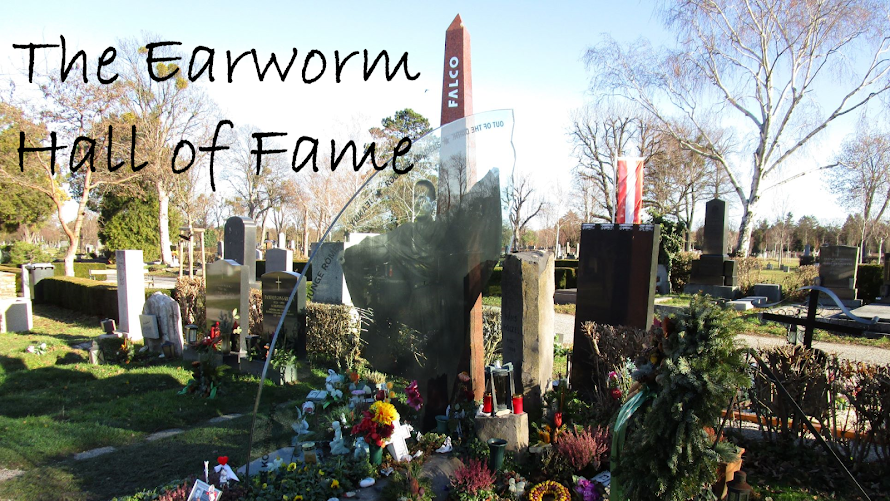
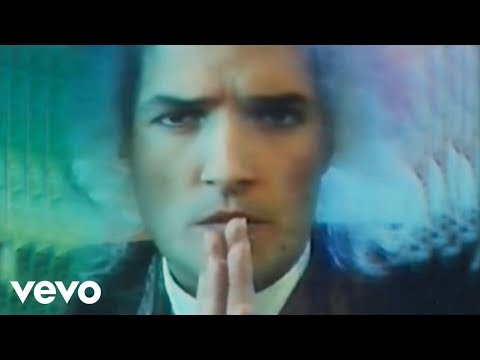
HOF Inductee No. 14: "Rock Me Amadeus," Falco

And we come to Falco. This is an earworm centered around the repeated incantation of the middle name of (possibly) (apologies to Ludwig von ...